Life Science and Technology News
【Labs spotlight】Sawada Laboratory
The Department has a variety of laboratories for Life Science and Technology, in which cutting-edge innovative research is being undertaken not only in basic science and engineering but also in the areas of medicine, pharmacy, agriculture, and multidisciplinary sciences.
This "Spotlight" series features a laboratory from the Department and introduces you to the laboratory's research projects and outcomes. This time we focus on Sawada Laboratory, which works on biomolecular design for biomedical applications, soft materials, and molecular sensing.
Areas of Supervision
Primary/Science and Technology for Health Care and Medicine
Secondary/Life Science and Technology,
Chemical Science and Engineering
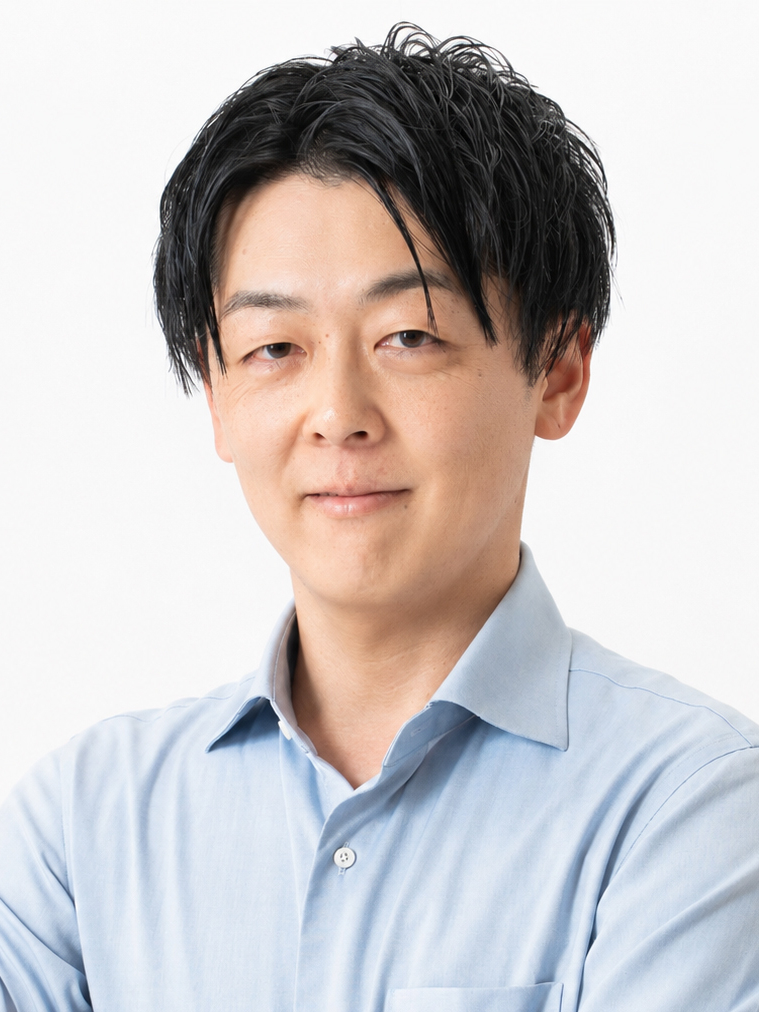
Professor Toshiki Sawada
| Office | Room 821, B2 building, Yokohama campus |
|---|---|
| Degree | PhD 2010, Tokyo Institute of Technology |
| Areas of Research | Biomolecular chemistry and engineering |
| Keywords | Peptide chemistry and engineering / Biopolymer Science / Biomedical applications and soft materials / Data-driven molecular design |
| Web site | Sawada Lab. |
Research interest
From Biomolecular Design to Biomedical Applications, Molecular Sensing, and Soft Materials
At the Sawada Laboratory, we focus on designable biomolecules such as peptides and filamentous phages, and develop them toward diagnostics, drug delivery, molecular sensing, and functional soft materials. We regard biomolecules not merely as objects to be observed, but as molecular entities whose sequences and structures can be designed and assembled to create new functions and properties.
A central question in our research is how differences in molecular sequence and structure lead to differences in assembled structures, molecular recognition, and function. We update our hypotheses based on experimental results and, when appropriate, incorporate statistical analysis and machine learning to feed the obtained insights back into the next stage of molecular design.
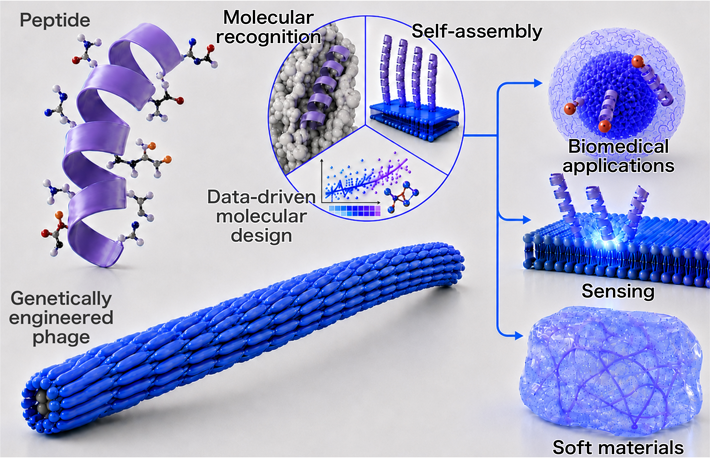
Overall view of biomolecular design based on peptides and phages
Functional Soft Materials and Molecular Systems Based on Genetically Engineered Phages
Filamentous M13 phage is a slender viral particle approximately 1 µm in length and several nanometers in diameter. It is a nanoscale structure in which many coat proteins are regularly arranged on the surface. By genetically modifying the amino acid sequences displayed on the phage surface, we can control intermolecular interactions, assembled structures, and functional properties.
We design functional soft materials and molecular systems, including gels, membranes, thermal transport materials, and molecular release systems, by exploiting the assembled structures of genetically engineered phages. We are also extending this platform toward biomedical applications, such as the control of amyloid-β peptide aggregation associated with Alzheimer’s disease, antibacterial and bactericidal applications, and the functionalization of phages to target cells and biomolecules.
In these studies, we experimentally investigate the relationships among phage surface sequences, assembled structures, and functional properties, while also using statistical analysis and machine learning to efficiently explore high-performing candidates. Through experimentally validated prediction and interpretation, we aim to elucidate the relationships among sequence, assembly, and function, and to obtain design principles that enable further functional enhancement.
Discovery and Design of Molecular-Recognition Peptides for Biomedical Applications and Molecular Sensing
Peptides are biomolecules whose molecular-recognition abilities and functions can be diversified by changing their amino acid sequences. We discover and design peptides that bind to target molecules, material surfaces, precisely defined oligomers, and molecular assemblies, and develop molecular tools based on these interactions.
Using such molecular-recognition peptides, we aim to develop biomedical applications, including diagnostics and drug delivery. In particular, we use peptides that selectively bind to target molecules and precisely defined oligomers to develop technologies for controlling molecular loading, spatial arrangement, release, and response. Based on these molecular-recognition technologies, we aim to functionalize biomolecules and to expand precisely defined oligomers toward biomedical applications such as diagnostics and drug delivery.
We also work on data-driven sensing systems that combine fluorescence responses, multivariate analysis, and machine learning to read out, identify, and classify differences among various molecules and materials. Rather than stopping at the discovery of “molecules that bind,” we aim to transform molecular recognition into molecular tools that can extract chemical information.
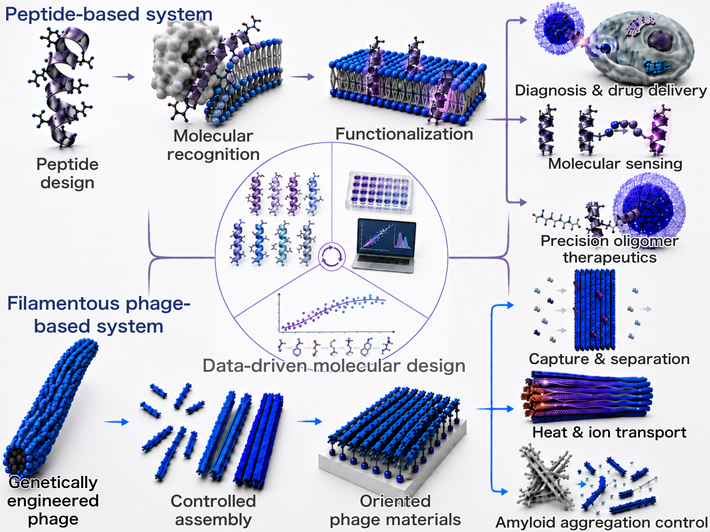
Workflow of peptide design, genetically engineered phages, and data-driven molecular design
Linking Experiments and Data to the Next Stage of Design
We position machine learning not as the central subject of our research, but as an accelerator for interpreting complex data obtained from experiments. Our goal is not only to improve the efficiency of exploration by predicting sequences, molecular structures, and assembly conditions that lead to enhanced functions, but also to translate the results into interpretable knowledge through contribution analysis and physicochemical interpretation. Experimental results that do not behave as expected are also valuable clues for the next hypothesis and design. We value careful observation, discussion, and iterative hypothesis refinement as essential parts of the research process.
Selected publications
- T. Sawada, N. Ueda, H. Marubayashi, M. Tokita, K. Numata, J. Morikawa, T. Serizawa, “Flow-Directed Hierarchical Assembly of Filamentous Viruses toward Filler-Free Soft Thermal Films”, ACS Appl. Nano Mater. 9(21), 9594-9602 (2026).
- S. Hasegawa, T. Sawada, Y. Kitazawa, M. Nagaoka, T. Kaneda. T. Serizawa, “Identification of Polymeric Nanoparticles Using Strategic Peptide Sensor Configurations and Machine Learning”, ACS Sensors 10(7), 5036-5046 (2025).
- Y. Sakurai, Y. Hata, M. Tashiro, R. Fujioka, T. Katashima, H. Marubayashi, T. Sawada, T. Serizawa, “Plant Cell Wall-Inspired Synthesis of Biomolecular Self-Assembled Stiff Hydrogels”, Commun. Mater. 6(1), 150 (2025).
- M. Tanaka, T. Sawada, K. Numata, T. Serizawa, “Tunable Thermal Diffusivity of Silk Protein Assemblies Based on Their Structural Control and Photo-Induced Chemical Cross-Linking”, RSC Adv. 14(18), 12449-12453 (2024).
- S. Hasegawa, T. Sawada, T. Serizawa, “Identification of Water-Soluble Polymers through Machine Learning of Fluorescence Signals from Multiple Peptide Sensors”, ACS Appl. Bio Mater. 6(11), 4598-4602 (2023).
- S. Suzuki, T. Sawada, T. Serizawa, “Identification of Water-Soluble Polymers through Discrimination of Multiple Optical Signals from a Single Peptide Sensor”, ACS Appl. Mater. Interfaces 13(47), 55978-55987 (2021).
- T. Sawada, Y. Murata, H. Marubayashi, S. Nojima, J. Morikawa, T. Serizawa, “Filamentous Virus-based Assembly: Their Oriented Structures and Thermal Diffusivity”, Sci. Rep. 8(1), 5412 (2018).
Other publications
researchmap(https://researchmap.jp/7000018144/published_papers?limit=20&start=1)
Contact
Professor Toshiki Sawada
Room 821, B2 building, Yokohama campus
E-mail : sawada@life.isct.ac.jp
Tel / Fax : +8145-924-5756
*Find more about the lab and the latest activities at the lab site.
*Aug. 19, 2026:Some of the content has been updated with the latest information.
Featured News
-
2026.07.22
-

2025.05.02
-
2024.08.08
-
2023.10.31