Life Science and Technology News
【Labs spotlight】Saito Laboratory
The Department has a variety of laboratories for Life Science and Technology, in which cutting-edge
innovative research is being undertaken not only in basic science and engineering but also in the areas of medicine,
pharmacy, agriculture, and multidisciplinary sciences.
This "Spotlight" series features a laboratory from the Department and introduces you to the laboratory's research
projects and outcomes. This time we focus on the Saito Laboratory, which explores frontiers in lipid biology and
drug discovery through organic synthesis and chemical biology.

Areas of Supervision
Primary/Science and Technology for health Care and Medicine
Secondary/Life Science and Technology
Associate Professor Yutaro Saito
| Office | Room 816, J3 building, Yokohama campus |
|---|---|
| Degree | PhD 2018, Nagoya University |
| Areas of Research | Organic Chemistry, Chemical Biology |
| Keywords | Organic synthesis, Lipid Biology |
| Web site | The Saito
Lab. (齋藤研究室) |
Research interest
Challenging the Uncharted Frontiers of Life Science through Organic Synthesis
Our research harnesses the power of organic synthesis, the technology for constructing molecules, to elucidate and create biological functions. In particular, we develop new synthetic technologies for lipids and apply them to explore uncharted frontiers in the life sciences.
Among the four major classes of biomolecules (nucleic acids, peptides, carbohydrates, and lipids), lipids possess the richest carbon-based structure and huge molecular diversity, making them especially well suited to organic synthesis. Nevertheless, compared with the other biomolecule classes, versatile synthetic methods capable of providing structurally diverse lipids remain underdeveloped. This limitation has significantly hindered progress in understanding lipid biology and exploiting lipids for drug discovery.
In other words, lipid science represents a vast frontier where advances in organic synthesis can unlock unprecedented opportunities for fundamental research, therapeutic innovation, and medical applications. By overcoming the synthetic challenges that define this field, we strive to create molecules, technologies, and knowledge that make a meaningful contribution to science and society.
1. Chemistry of the Fourth Chain of Life—Chemical Synthesis of Life Carbon Chains (Fatty Acid Chains) and Elucidation of Their Biological Functions
We use the term “chains of life” to describe chain-like molecules that play central roles in biological processes. Traditionally, the chains of life refer to three major classes: (1) DNA and RNA chains (nucleic acids), (2) peptide chains (proteins), and (3) glycan chains (carbohydrates).
Lipids, which together with nucleic acids, proteins, and carbohydrates constitute the four major classes of biomolecules, also contain chain-like molecules that are indispensable for life: fatty acid chains. When structures that have not yet been discovered in nature are also considered, fatty acids are theoretically capable of exhibiting a diversity of tens of thousands of molecular species or more. Furthermore, because many lipid molecules contain fatty acid chains, the various combinations of fatty acid chains incorporated into individual molecules generate an enormous diversity of lipid structures.
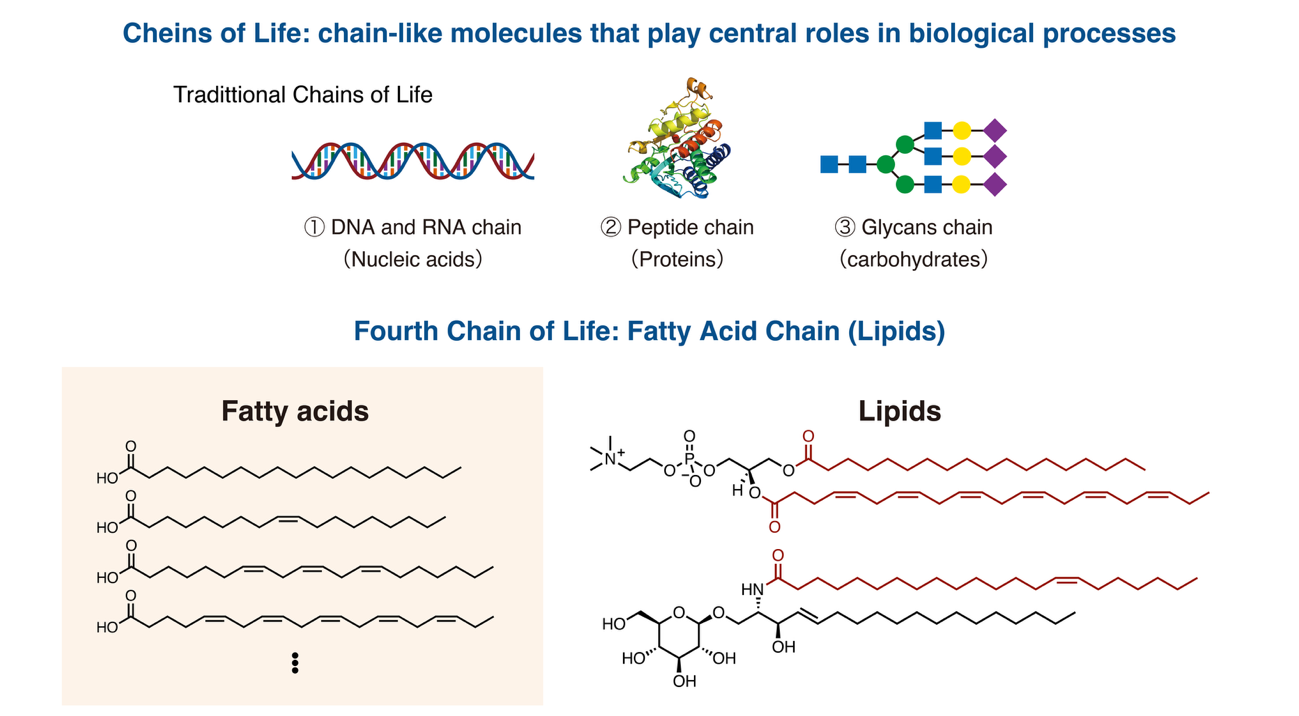
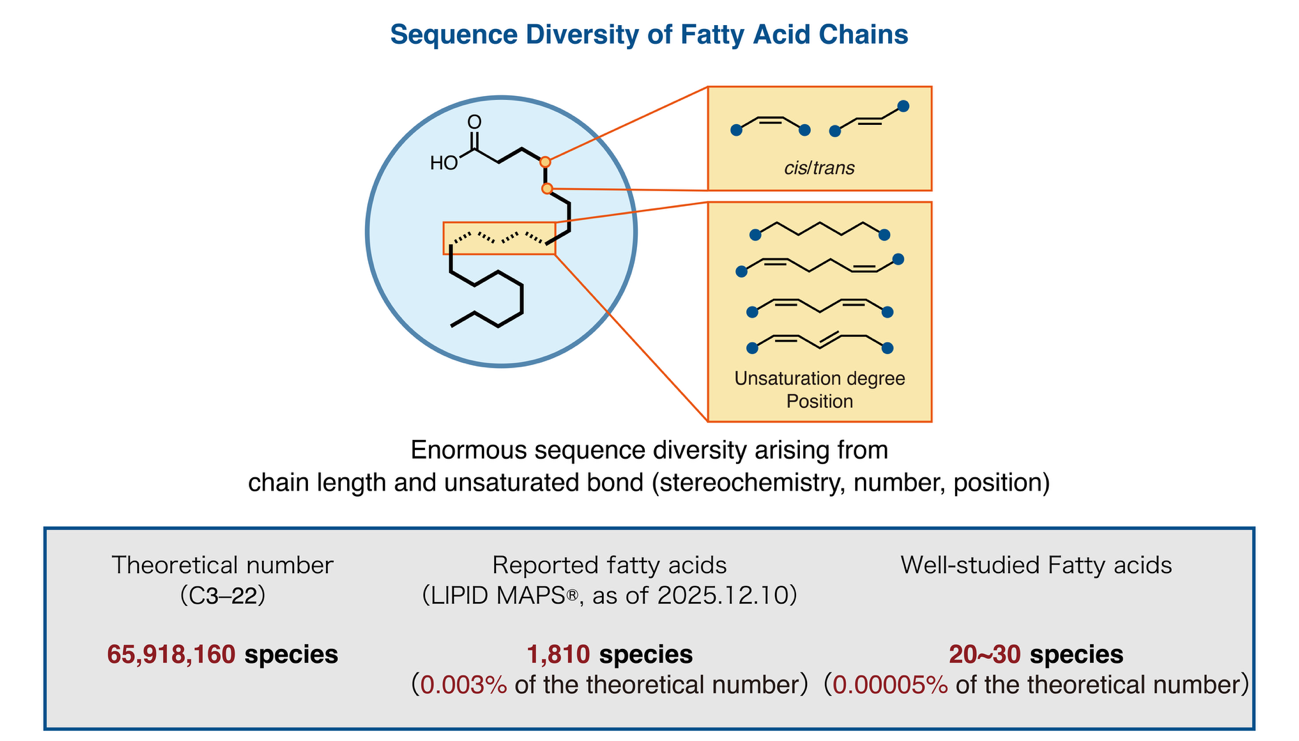
Naturally occurring fatty acids generally consist of linear hydrocarbon chains. Their structural diversity arises from combinations of chain length, degree of unsaturation, the position and stereochemistry of double bonds, and the presence of functional groups, giving rise to theoretically tens of thousands of possible structures. If this arrangement of structural elements is regarded as a "sequence," the functions of fatty acid chains can be viewed as being governed by highly diverse sequences, much like the conventional chains of life (nucleic acids, proteins, and glycans).
In contrast, the relationship between fatty acid chain sequences and biological functions remains almost entirely
unexplored. For example, among biologically relevant fatty acids containing 3–22 carbon atoms, considering only the
number, position, and stereochemistry (cis/trans) of double bonds yields approximately 66 million theoretically
possible sequences. In reality, fatty acids with more than 22 carbon atoms also exist, as do those bearing
functional groups such as hydroxyl groups, increasing the potential sequence diversity to an astronomical scale.
Despite this enormous chemical diversity, fewer than 2,000 fatty acids have been identified to date, and only approximately 20–30 have been studied in detail. In other words, the vast majority of fatty acid chain sequences remain functionally unexplored. We therefore believe that the chemical space of fatty acids represents a vast reservoir of undiscovered biological functions.
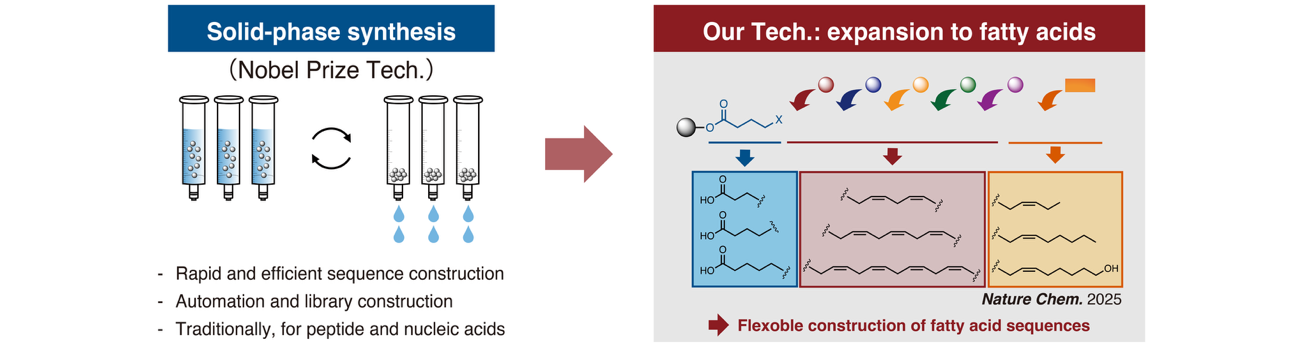
In our laboratory, we tackle this fundamental challenge in life science through the power of organic synthesis. To elucidate and understand the relationship between fatty acid chain sequences and the diversity of biological functions, it is essential to develop technologies that enable the precise and versatile construction of fatty acid chains. Until recently, however, no such methodology existed.
By contrast, in the fields of nucleic acids, peptides, and glycans, solid-phase synthesis (Nobel Prize in Chemistry, 1984) has enabled researchers to construct molecular chains with precise sequence control. Our goal is to extend this concept to fatty acids and lipids by establishing solid-phase synthetic methods that allow fatty acid chains to be constructed at will. Through this technology, we aim to elucidate the biological functions governed by fatty acid chain sequences, deepen our understanding of lipid biology, and ultimately translate these discoveries into advances in medicine and drug discovery.
In other words, we challenge an unexplored frontier in life science—the relationship between fatty acid chain sequences and biological functions—through the power of molecular construction, namely organic synthesis.
2. Lipid-Based Drug Discovery—Pioneering a New Drug Modality that Targets Biological Membranes
The term drug modality refers to the class of therapeutic molecules and the strategies used for drug discovery. Representative drug modalities include small molecules, antibodies, nucleic acids, and peptides. In general, therapeutic agents exert their effects by modulating the functions of biomolecules, either by inhibiting or activating them, thereby treating disease. Importantly, each drug modality can access only a specific subset of biological targets.
For example, most small-molecule drugs regulate protein function by binding to the active sites of enzymes or receptors. Although small molecules have long been the dominant drug modality, many biological targets remain inaccessible to them, driving the development of antibody therapeutics, nucleic acid therapeutics, and peptide therapeutics. Nevertheless, even these established modalities cannot collectively address every biological target or treat every disease. The creation of entirely new drug modalities therefore remains one of the most important challenges in modern drug discovery.
One representative example of a target that remains largely inaccessible to existing drug modalities is the biological membrane, including the plasma membrane and the membranes of intracellular organelles. Biological membranes are far more than passive barriers; they play central roles in regulating cellular functions. For example, changes in the composition and relative abundance of membrane lipids alter membrane properties such as fluidity, flexibility, and thickness, thereby modulating the activities of membrane-associated enzymes and proteins. Membrane properties also influence molecular permeability and cellular motility, profoundly affecting cellular behavior. Although abnormalities in biological membranes are known to be associated with numerous diseases, no therapeutic modality has yet been established to directly control the physical properties and functions of biological membranes.
To address this challenge, we focus on fatty acids and lipids as a new drug modality for targeting biological membranes. As the principal constituents of biological membranes, lipids can alter membrane properties and functions when exogenously supplied. As described above, fatty acids and lipids exhibit enormous structural diversity, the vast majority of which remains functionally unexplored. By developing our own synthetic technologies to create diverse lipid molecules, we aim to establish a new paradigm of lipid-based drug discovery.

Selected publications
Selected publications
- "Expedited access to polyunsaturated fatty acids and biofunctional analogues by full solid-phase synthesis"
Yutaro Saito, Mayuko Akita, Azusa Saika, Yusuke Sano, Masashi Hotta, Jumpei Morimoto, Akiharu Uwamizu, Junken Aoki, Takahiro Nagatake, Jun Kunisawa, Shinsuke Sando
Nat. Chem. 2025, 17, 1391–1400. DOI: 10.1038/s41557-025-01853-5 - "Solid-phase synthesis of polyunsaturated fatty acids facilitates precise structural investigation on FFAR1/4
agonist activities and the inhibition of neutrophil pseudopod formation"
Yaohong Shi, Yutaro Saito, Masashi Hotta, Mayuko Akita, Akiharu Uwamizu, Junken Aoki, Jun Kunisawa, Shinsuke Sando
RSC Adv. 2025, 15, 32263–32270. DOI: 10.1039/d5ra04836b
Web site for all publication
Contact
Associate Professor Yutaro Saito
Room 816, J3 building, Yokohama campus
E-mail : saito.y.cadb@m.isct.ac.jp
Tel / Fax : +8145-924-5041
*Find more about the lab and the latest activities at the lab site.
Featured News
-
2026.08.06
-

2025.05.02
-
2024.08.08
-
2023.10.31