Life Science and Technology News
Exploring how gut bacteria alter the flavor of Black Ivory coffee beans
Bacterial enzymes in elephants’ guts may digest pectin and give beans a smooth, chocolaty, and less bitter flavor
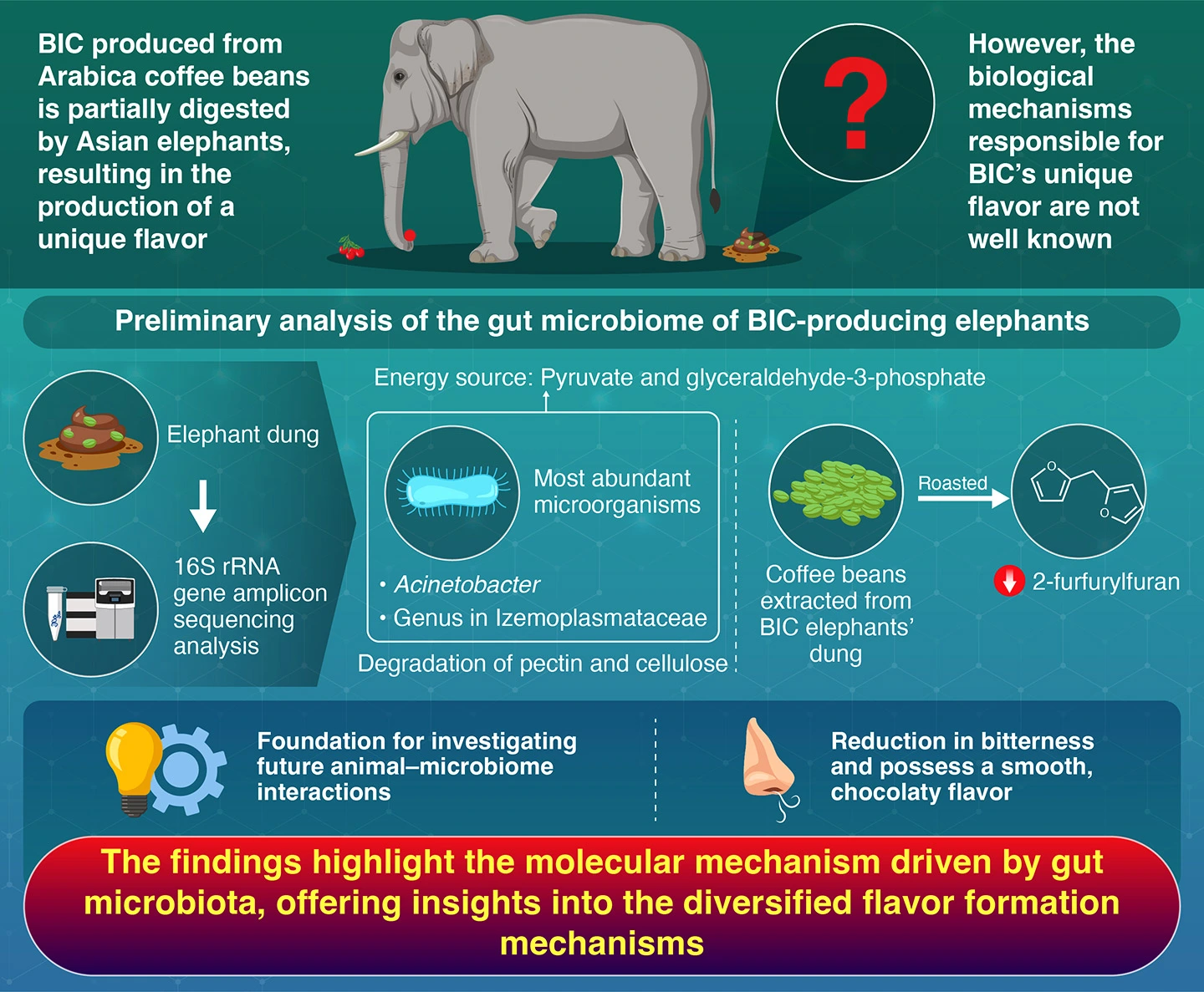
Coffee beans that pass through the digestive tracts of animals get their unique flavors from the activity of gut microbes, report researchers from the Institute of Science Tokyo. The guts of Asian elephants that produce Black Ivory coffee (BIC) were rich in pectin-digesting bacteria. Heat-driven degradation of pectin during roasting makes coffee bitter. Bacterial activity that reduces the pectin content of BIC could be the source of its smoother, chocolaty, and less bitter flavor.
Investigating Pectin-Degrading Gut Bacteria in the Production of Black Ivory Coffee (BIC)
With hundreds of millions of cups consumed every day, coffee is one of the most popular beverages in the world. Many
organic molecules combine to give coffee its flavor, and nearly every coffee drinker likes a different flavor
profile that is "just theirs." The food industry has developed many ways of processing coffee beans to
alter the ratios of these molecules and create the unique flavors consumers can enjoy.
One particularly interesting process involves passing coffee beans through the digestive tracts of animals. An
emerging example is Black Ivory coffee (BIC). BIC is made in only one elephant sanctuary in Thailand. Asian
elephants are fed Arabica coffee cherries, and beans collected from their dung are processed for human consumption.
BIC is prized for its smooth, chocolaty flavor, and it is less bitter than regular coffee.
A research team led by Associate Professor Takuji Yamada and Research Fellow Nodoka Chiba from the School of Life
Science and Technology, the Institute of Science Tokyo (Science Tokyo), Japan, have tried to identify the
biochemical processes that give BIC its unique flavor. Their work, published in Volume 15 of the journal Scientific Reports on
November 18, 2025, helps uncover some of the secrets behind BIC.
on
November 18, 2025, helps uncover some of the secrets behind BIC.
"Our previous study revealed that Gluconobacter was the dominant genus in the gut of civet cats, and it
may produce volatile compounds from the coffee beans, suggesting that microbial metabolism contributes to the coffee
aroma," says Yamada. He adds, "These findings raised the question of whether the gut microbiome of
elephants similarly influences the flavor of BIC."
The team analyzed fresh dung from elephants producing BIC, as well as from control elephants living in the same
elephant sanctuary. The only difference in their diets is that BIC-producing elephants received an additional snack
of bananas, rice bran, and whole coffee cherries. Any differences in the content and composition of fecal microbes
would be due to this snack.
Yamada’s team found that BIC-producing elephants’ dung was unusually rich in pectin-digesting enzymes. 16S ribosomal
RNA analysis showed that these elephants also had a more diverse gut microbiome, with an abundance of Acinetobacter
and other pectin-digesting species. "Interestingly, Acinetobacter has also been detected on the surface of
coffee beans. This suggests that ingestion of coffee beans may lead to the colonization of specific microbes in the
gut of elephants," remarks Yamada.
Pectin in coffee beans is partially broken down by the heat of roasting and seems to form bitter-tasting compounds such as 2-furfuryl furan. Previous studies showed that BIC had much lower levels of 2-furfuryl furan than regular coffee beans. These earlier findings appear to be explained by the discovery of pectin-digesting bacteria in the gut of BIC-producing elephants. Since pectin is partially digested as the beans pass through the elephants’ guts, there is less available to form 2-furfuryl furan when the beans are roasted.
"Our findings may highlight a potential molecular mechanism by which the gut microbiota of BIC elephants
contributes to the flavor of BIC," says Yamada as he describes these exciting findings. "Further
experimental validation is required to test this hypothesis, such as a biochemical analysis of coffee bean
components before and after passage through the elephant’s digestive tract," he adds, pointing to avenues for
future research into this technique for processing coffee.
Nevertheless, this study provides a foundation for further exploration of animal-microbiome interactions in food
fermentation and flavor development. Continued research into specific microbial metabolic mechanisms may support the
development of diverse and distinctive flavor profiles in the future!
Reference
| Authors: | Nodoka Chiba1, Vachiranee Limviphuvadh2, Chong
Han Ng3, Ryuto Koyagi1, Yuta Kino1, Yuya Nakamura1,6, and Takuji Yamada1,4,5,6* *Corresponding author |
|---|---|
| Title: | Preliminary Study of Gut Microbiome Influence on Black Ivory Coffee Fermentation in Asian Elephants |
| Journal: | Scientific Reports |
| DOI: | 10.1038/s41598-025-24196-0
|
| Affiliations: | 1School of Life Science and Technology, Institute of
Science Tokyo, Japan 2Biomolecular Sequence to Function Division (BSFD), Bioinformatics Institute (BII), Agency for Science, Technology and Research (A*STAR), Singapore 3Faculty of Information Science & Technology, Multimedia University, Malaysia 4Metagen, Inc., Japan 5Metagen Therapeutics, Inc., Japan 6digzyme, Inc., Japan |
Related articles
- Personalized Gut Microbiome Analysis for Colorectal Cancer Classification with Explainable AI | Life Science and Technology News
- New simple storage method for faecal samples offers improvements in the metagenomic analysis and the study of disease | Life Science and Technology News
- Takuji Yamada - Early cancer intervention with gut bacteria | Life Science and Technology News
- Takuji Yamada | Science Tokyo Research Information DB - Science and engineering fields
- Department of Life Science and Technology, School of Life Science and Technology
- School of Life Science and Technology
Further information
Professor Takuji Yamada
School of Life Science and Technology, Institute of Science Tokyo, Japan
Email info@jchm.jp
Featured News