Materials Science and Engineering News
Science Tokyo Museum hosts science workshop for fabricating ferrite magnets
The Science Tokyo Museum hosts an annual science program for middle and high school students, dedicated to cultivating the next generation of scientists and engineers.
This year, in collaboration with the Department of Materials Science and Engineering, the museum hosted a science workshop on February 23. "Exploring the World of Ceramics through Hands-on Learning: Fabricating Ferrite Magnets — A Renowned Innovation of Science Tokyo" was held at one of the student laboratories on Ookayama Campus. The event welcomed 20 participants and was generously supported by AirTrunk, Fujitsu Limited, and the STEAM Education for Younger Generations arm of the Science Tokyo Fund.
Ferrites, a quintessential class of magnetic ceramics, were developed in the 1930s by a research group led by Professors Yogoro Kato and Takeshi Takei at Tokyo Institute of Technology (Tokyo Tech), Science Tokyo’s predecessor. Their breakthrough led to the successful commercialization of the technology and the founding of TDK Corporation, serving as a preeminent example of a successful university-born startup. Today, ferrite-related materials and products are indispensable to global infrastructure and daily life. This workshop was designed to provide students with a profound experiential understanding of ferrite’s material properties.
Under the guidance of Kazuo Shinozaki, a professor emeritus at Science Tokyo, Osamu Sakurai, a former associate professor at Tokyo Tech, and Hidemi Yoshikawa, a technical specialist at the Institute, the program commenced with a lecture by Shinozaki on advanced functional ceramics. He explained the unique properties of ferrites, their manufacturing methodologies, and their diverse industrial applications.
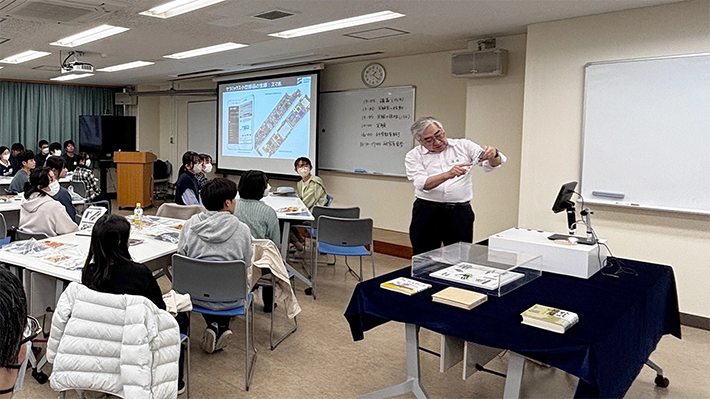
Shinozaki demonstrating industrial applications of ferrite during his lecture
In the subsequent hands-on session, students fabricated ferrite magnets under varying conditions and evaluated their magnetic strength by measuring attractive and repulsive forces. While traditional ferrite production requires high-temperature sintering, the instructors developed a specialized pressure-molding process for this workshop. By mixing ferrite particles with resin, students were able to successfully form magnets within a limited timeframe — a process validated through rigorous preliminary testing by the faculty.
The technical sequence of the experimental procedure and analysis was as follows:
- 1.Precision weighing of ferrite powder
- 2.Formation of ferrite pellets via pressure molding
- 3.Measuring the dimensions of the ferrite pellets
- 4.Magnetization
- 5.Quantitative measurement of magnetic force
- 6.Assessment of remanent magnetic moment
- 7.Graphical representation of experimental data
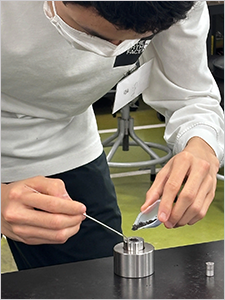
Participant putting ferrite powder into press mold
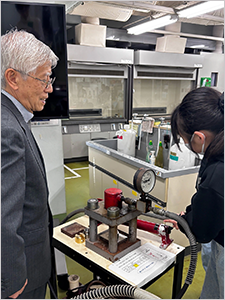
Sakurai (left) supervising student during pressure-molding process
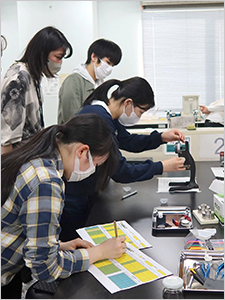
Participant characterizing dimensions
of fabricatedferrite pellet
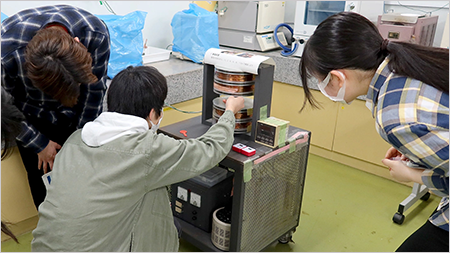
from magnetization apparatus
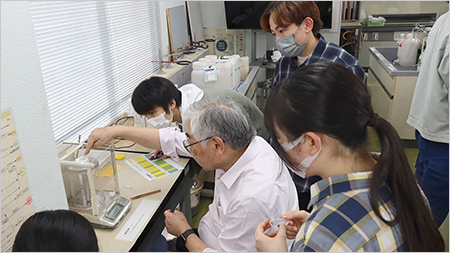
magnetic force using an electronic analytical balance
Supported by student staff members, participants engaged enthusiastically with specialized laboratory equipment. Following the experiments, Shinozaki demonstrated how to interpret the resulting data, guiding students in the analytical process of inferring physical properties from empirical evidence.
To conclude the program, participants visited the Ikoma-Anraku Laboratory and Matsushita-Kubota Laboratory, taking advantage of a rare opportunity to witness firsthand the cutting-edge ceramics research currently being conducted at the forefront of the field.
Comments from participants
- It was a privilege to utilize sophisticated laboratory equipment seldom available in a standard high school curriculum.
- Unlike school experiments with predetermined outcomes, this open-ended inquiry was intellectually stimulating.
- As an aspiring researcher, engaging in foundational work at the forefront of the field was an invaluable experience.
- The concluding analysis was exceptionally rigorous and profoundly insightful.
Related articles
- Tokyo Tech Museum science class shares magical properties of nanofibers with public | Former Tokyo Tech
- Youngsters create sea urchin lamps at online science workshop | Former Tokyo Tech
- Materials Science and Engineering Graduate Major | Education | Department of Materials Science and Engineering, School of Materials and Chemical Technology, Science Tokyo
- School of Materials and Chemical Technology
- Science Tokyo Fund
- Science Tokyo Fund for STEAM (Japanese)
- Museum and Archives
- AirTrunk
- Fujitsu Limited
Featured News